Monday, April 20, 2015

Future Powerhouses: Economics in Action!


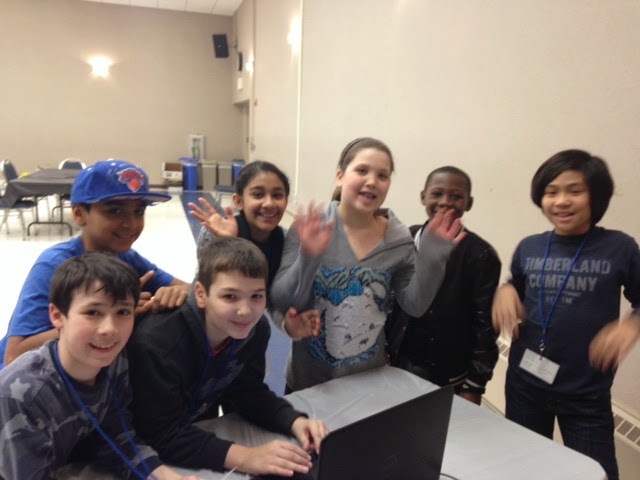
On March 31, 2015, approximately 50 Newburgh fifth-graders, with their own college IDs and course schedules, became college students for the day, attending mini-classes and pushing themselves through athletic practice while interacting with 60 Mount Saint Mary College student volunteers.

The "College Sneak Peek" Event:

This Mount Saint Mary College event was cosponsored by the Conversations to Inspire Reading Children's Literature with Engagement Club (CIRCLE),the Men's Lacrosse team, and the Women's Soccer team. After organizing and executing a successful read-a-thon in fall 2014 as featured in the Poughkeepsie Journal, CIRCLE was approached by a local elementary school to arrange a similar experience for the whole fifth-grade which would serve as the students' field-trip. Understanding that, "Students apply to college in their senior year, but it is at least five years earlier, in the middle grades, when students really make the decision to go to college, and more importantly, when they must start taking steps to make that decision a reality," I understood that CIRCLE was
being provided an immense opportunity to greatly influence the course of fifty students' lives at a critical time (Breakthrough Collaborative, 2010, p. 1). Similarly, Robert Balfanz (2009) writes in "Putting Middle Grade Students on the Graduation Path" that, "It is during the middle grades that students either launch toward achievement and attainment, or slide off track and placed on a path of frustration, failure, and, ultimately, early exit from the only secure path to adult success" (p. 13). Knowing that many of the fifth-graders had not before stepped on a college campus and did not have family members or close family friends who attended college, it became our mission to have the concept of "college" and all of its benefits become part of students' knowledge. 


To meet our goal, we wanted students to learn about the admissions process and how to prepare for college, social life at college, and academic pursuits of college. Luckily CIRCLE had great support from the MSMC Admissions Department which arranged an information session and tour emphasizing not only the strengths of Mount Saint Mary College, but also the opportunities that generally come with attending college. Then, students were able to witness this message in action when they participated with MSMC students, more specifically members of the Men's Lacrosse and Women's Soccer teams, to experience athletics and get a taste of college sports practices. Next, CIRCLE members planned and implemented, with the help of Men's Lacrosse players and other MSMC volunteers, four mini-classes in some of the areas in which MSMC offers majors. In the nursing class, fifth-graders studied the relationship between heart rate and level of activity; in the math/science class, students studied slope and velocity by racing cars down ramps of different slopes; in the English class, students watched a video clip of college students protesting fossil fuel divestment and then debated environmental issues; in the combined business and information technology class, students created their own companies complete with a company website, t-shirt product, and video recording of their product commercial or pitch to venture capitalists just like on Shark Tank. During all of these "classes", the fifth-graders were treated as real college students working alongside MSMC students to accomplish tasks and gain an appreciation for college. 
   
Focusing on developing students' career and college readiness goes hand-in-hand with our goal as social studies educators to promote civic competence. Wanting students to actively engage with the college experience and feel like they were working as college students as opposed to being taught, CIRCLE members developed mini-classes based on constructivist tenets. In each mini-class, students were actively engaged as two of the mini-classes incorporated technology, and the other two were hands-on activities. Students explored each mini-class with peers which helped to build social interaction skills and heighten the experience: "Learning reflects a social process in which children engage in dialogue and discussion with themselves as well as with others (including teachers) as they develop intellectually" (Reys, Lindquist, Lambdin, & Smith, 2012, p. 22). 

Fostering Entrepreneurship through Economics: 
As I discussed in an earlier blog, one of the disciplines within social studies is economics. Economics studies how to balance infinite wants with scarce resources to make wise decisions. Therefore, most business decisions are economic decisions. During the event, fifth-graders worked with MSMC Business and Information Technology majors to create their own company websites. Nicole and I developed the structure of the mini-lesson by adapting ideas from Bizworld In short, Bizworld offers "hands-on, engaging programs...that teach valuable lessons about entrepreneurship, business, and financial responsibility while emphasizing the importance of valuable skills like collaboration, critical thinking, leadership, and creativity"(Bizworld: Making Entrepreneurship Fun for Kids). Allotting only thirty minutes for each group to actively engage in the mini-class, we had to select specific focuses of the program and adapt them to meet the needs of the event and students with whom we were working. We selected the following activities within the BizMovie program to adapt: 
 

The first change that I made was to not utilize worksheets as BizMovie does. Filling out worksheets would have wasted precious time and I felt it was more valuable for students to be thinking about, discussing, and apply the concepts instead, as they would in a true college setting. Therefore, the thirty-minute workshop utilized the activities of the worksheets above, but transformed them into the following experience: 

  1. Fifth-graders and college students discussed what it means to be a business or information technology major at Mount Saint Mary College. College students shared their career goals for after graduation and how these majors would prepare them to reach those goals.
  2. Next, students were presented with their real-world problem: Create a business. Each group of students' "company," was provided with a user-friendly website template from Google Sites. Students were asked to create the homepage of the website by displaying the company name created by the students, the names of the entrepreneurs creating the company, and to explain the mission of the company, the product they are selling, and their target buyers. 
  3. Entrepreneurs then needed to design t-shirts for the company. Some companies decided that the t-shirts would be the main product being sold, while other companies selected to have t-shirts just be one of the products being sold to raise awareness for the company's bigger mission. Students then selected a price for the shirt and had to justify why they selected that price. Did it need to be easy for poorer people to buy as well? Is it a novelty item that not a lot of people should be wearing? 
  4. Lastly, some companies created a video-recorded pitch to venture capitalists (as the students had seen on the popular show, Shark Tank) while others preferred to create a commercial to entice the public to purchase their product! 
This workshop was meaningful because it provided students an authentic task that taught "important ideas for understanding, appreciation, and life application" (NCSS). Additionally, because of the set up of the entire event, the presence of college students majoring in business and information technology, and the company website, "the significance and meaningfulness of the content was emphasized both in how it was presented to students and how it was develop through activities" (NCSS). The mini-class was integrative because it required students to create their own websites, company names, products, and pitches by channeling their personal "beliefs, values, and attitudes" (NCSS). Similarly, the students' active experience promoted their digital literacy as students worked first hand with a laptop building their company websites through Google Sites, and designing t-shirts with an interactive website. The mini-lesson can also be described as value-based as many companies designed products to help people, and made decisions about the cost of their products based on how it would impact people of different economic backgrounds. Therefore, they "consider[ed] the costs and benefits to various groups that are embedded in potential courses of action" (NCSS). Fourthly, the workshop was challenging for students because they were required to reconcile their ideas with other entrepreneurs to best meet the needs of their companies. Additionally, groups had to critically evaluate what would motivate venture capitalists to invest in their companies and what would motivate potential customers to buy their products. Lastly, students were active throughout the mini-class, constructing their own meaning of the concepts of "business" and "entrepreneurship," and making decisions for the health of their companies. Students were afforded the opportunity to be "independent and self-regulated learners" during an "authentic activity that called for real-life applications using the skills and content of the field" (NCSS). 

Examples of Student Websites: Smartbots and Air Floaters
 References

Balfanz, R. (2009). "Putting Middle Grades Students on the Graduation Path."Association for Middle Level Education - AMLE

Breakthrough Collaborative. (2010, January 1). Middle school: The fork in the road to college. Retrieved April 16, 2015, from https://www.breakthroughcollaborative.org/sites/default/files/bt-research-brief-ms-fork-in-the-road.pdf

National Council for the Social Studies. “Principles of Teaching and Learning.” Expectations of Excellence: Curriculum Standards for Social Studies.

Reys, R.E., Lindquist, M., Lambdin, D.V., & Smith, N.L. (2012). Helping children learn mathematics (10th ed.). Hoboken, NJ: Wiley. 

Tuesday, April 14, 2015

Producing Economically Savvy Decision-Makers

     
   E C O N O M I C S   

"Economics is defined as a social science that studies how individuals, governments, firms and nations make choices on allocating scarce resources to satisfy their unlimited wants. Economics can generally be broken down into: macroeconomics, which concentrates on the behavior of the aggregate economy; and microeconomics, which focuses on individual consumers" (Investopedia).


As social studies educators, our goal is civic competence for all of our students. Without knowledge of economics and the ability to evaluate economic concepts when making financial decisions, students cannot fully function in our democratic society. For instance, voters today cannot understand and choose between the domestic economic policies of presidential candidates without understanding macroeconomic concepts like the the relationship between taxation and job creation. However, the importance of economics is even simpler to understand when considering the decisions people need to make daily. In short, people need to have the wherewithal to differentiate between needs and wants and work within a budget. 


For my economics project, I focused on teaching students how to make the necessary choices that are required when infinite wants surpass available resources (money), using decision-making models. While economic concepts can be very abstract, students are often motivated by working with money and do have personal knowledge of spending money and having unfulfilled wants which teachers can target to make economic lessons meaningful for students.

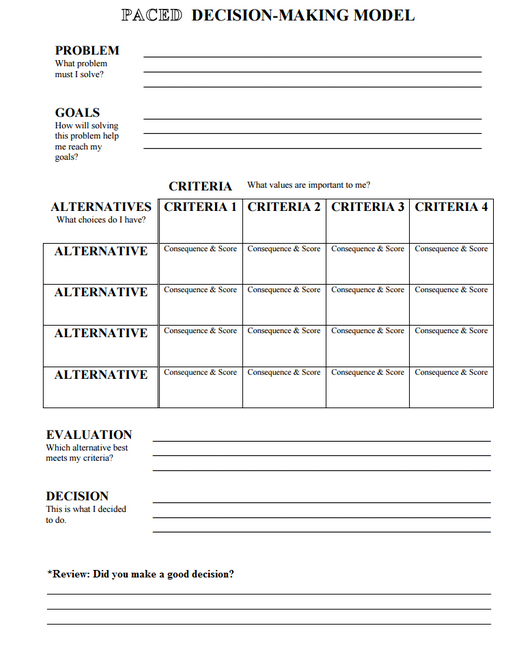
As part of my presentation, I provided a guideline for how students should work through the decision-making model. Much like the inquiry process, students are required to analyze information before drawing a conclusion/making a decision. I explained that the PACED model leaves out a key component of good decision-making: Reflection to evaluate whether a decision was correctly made. I purposefully added this onto the guide because reflection is key to students becoming self-evaluative and developing metacognitive skills. As I discussed in an earlier blog, making decisions in a vacuum without reflection would not be valuable over the long-term because students would not consider how they could improve in the future and grow in their abilities. Dunning, Johnson, Ehrlinger, and Kruger (2003) found that without metacognitive skills, "people [who] lack the skills to produce correct answers, are also cursed with an inability to know when their answers, or anyone else’s, are right or wrong” (p. 85). Our hope is that teaching students to reflect back on decisions they previously made will help them to grow as decision-makers over time.

Image result for no free lunch milton friedman

Just as the teacher or students pose questions as part of the inquiry process, the teacher or students can pose a problem in which there exist many alternatives for students to consider the best possible alternative. Considering alternatives to best solve the problem requires students to analyze the restraints caused by scarcity and the opportunity cost of what is lost when an alternative is selected. Kelli explained both of these ideas in her slides, emphasizing that scarcity forces choices to be necessary and that when one alternative is chosen the other becomes the opportunity cost. Thus, with every decision, something is always lost: The path not taken. Furthermore, the best way to pose a meaningful problem is to make it relate to the students' lives outside of the classroom. This will also encourage students to apply the decision-making process to choices in front of them when they leave classroom. Nicole, in her slides, provided examples of how economics influences the lives of all people, including children. As I explained earlier, students know what it is like to want something and not be able to have it. Similarly, students are fully aware that some people are able to obtain more of their desires because they have access to more resources than others. Therefore, I also provided links of concrete examples of problems that students can answer using the PACED model, pictured above, to master the economic decision-making: Food, gift certificates, and classroom supplies. I particularly like the classroom supplies activity in which students are given a set budget and then they
need to make choices about what supplies should be selected and which should be left as opportunity costs because it reminds me of the school funding activity in which I actively participated during my Orientation to Teaching course. I still remember the experience semesters later, and was able to form generalizations about the role of funding in school districts' decision-making. I want to provide my students with a similar experience.

Additionally, I just want to stress that the discipline of economics, like many of the other disciplines within social studies, is all around us and constantly part of daily life. Thus, teachers will be presented with many unplanned teachable moments in the area of economics. Mark Schug, author of Economics for Kids: Ideas for Teaching in the Elementary Grades (1986) asserts that teachers should capitalize on informal opportunities to review economic concepts when they present themselves in the news or the classroom. If a student needs to make a decision in which there are multiple alternatives, encourage him or her to use an economic decision-making model. Let students' questions and problems lead to genuine and value-based economic lessons.

References

Chick, N. (n.d.). Metacognition. Retrieved April 13, 2015, from http://cft.vanderbilt.edu/guides-sub-pages/metacognition/

Dunning, D., Johnson, K., Ehrlinger, J., & Kruger, J. (2003) Why people fail to recognize their own incompetence. Current Directions in Psychological Science, 12(3), 83-87.

Economics Definition | Investopedia. (2003, November 18). Retrieved April 14, 2015, from http://www.investopedia.com/terms/e/economics.asp

Schug, M. C. (1986). Economics for kids: Ideas for teaching economics in the elementary grades. Washington, DC: Joint Council on Economic Education and the National Education Association. 

The Economics Detective. (2012, July 14). What is Economics? Retrieved April 14, 2015, from https://www.youtube.com/watch?v=2YULdjmg3o0


Monday, April 13, 2015

Geography Integration


In May 2006, an NBC News article, titled "Young Americans shaky on geographic smarts," found in polling 510 young Americans that:
  1. While Israeli-Palestinian strife has been in the news for the entire lives of the respondents, 75 percent were unable to locate Israel on a map of the Middle East.
  2. One-third of respondents couldn't pinpoint Louisiana on a map and 48 percent were unable to locate Mississippi.
  3. While the outsourcing of jobs to India has been a major U.S. business story, 47 percent could not find the Indian subcontinent on a map of Asia.
How knowledgeable are you of world geography? Take the quiz


As discussed in my current events blog, effectively teaching social studies requires that educators integrate the many disciplines within social studies into their units. One such discipline, which I integrated into my current events lesson by using nonfiction articles around the world and having students employ Google Earth in their presentations, is geography and based on the NBC poll discussed above, it might be in need of increased and more effective focus in our schools. In the NBC article (2006), National Geographic president John Fahey said: "Geographic illiteracy impacts our economic well-being, our relationships with other nations and the environment, and isolates us from the world." The National Council for the Social Studies seems to agree with Fahey's assertion of the critical importance of geographic knowledge given its own standards for student achievement. While I contend that all of the themes can and should integrate geography, because geography sheds light on all of the themes- production, governance, identity, culture, the emphasis on geography is most clearly visible in NCSS Theme #3  "People, Places, and Environments." Specifically, NCSS states that students will study geography to: "acquire a useful basis of knowledge for informed decision-making on [social, cultural, economic, and civic] issues arising from human-environmental relationships."

To truly study geography and develop the well-rounded knowledge base desired by NCSS, students must ask and answers questions relating to the five themes of geography.   


Students explore the relationship between humanity and the environment. For instance, humans depend upon the natural world for survival (food, shelter) and adapt to meet additional needs (develop technology). 


Students determine the absolute location of a place by determining its exact location using longitude and latitude coordinates. Students approximate relative location by comparing locations to one another. Example: Chile's relative location is between Argentina and the Pacific. 

Students explore a place by finding out what happens there both physically and with humans. Places can be characterized by their topography, vegetation, climate, population density, government, religion, language, etc. 

Students can classify places into regions that share characteristics and determine within which regions an area belongs. Similarly, students can compare and contrast different regions.  

Students learn the extent to which the world is interconnected. The movement of people, goods, and ideas cause global relationships; particular issues can have international effects.


In order to engage students in geography, an online collaboration of geography educators has designed "103 creatively simple ways to teach geography." Of these 103 ways, I have selected ten that I would like to utilize in my future classroom. 


10. Having students create wordles featuring certain places after having researched them allows students to summarize their findings about the human and physical characteristics of a place and draw conclusions. Perhaps all of the description words in the wordle can help a group to classify the place within a certain region. Another activity is that students could create wordles without the name of the place. Then, other students could have to investigate the words in the wordle to uncover the place in question. 


9. I can remember creating travel brochures of foreign places in my elementary years to gather and present information on a place unfamiliar to classmates. Now, e-cards represent a more technologically advanced project to meet the same objective. Students would need to research all of a place's highlights, thus incorporating the themes of place, interaction, and region, as well as provide its absolute and relative location to encourage others to travel there. 


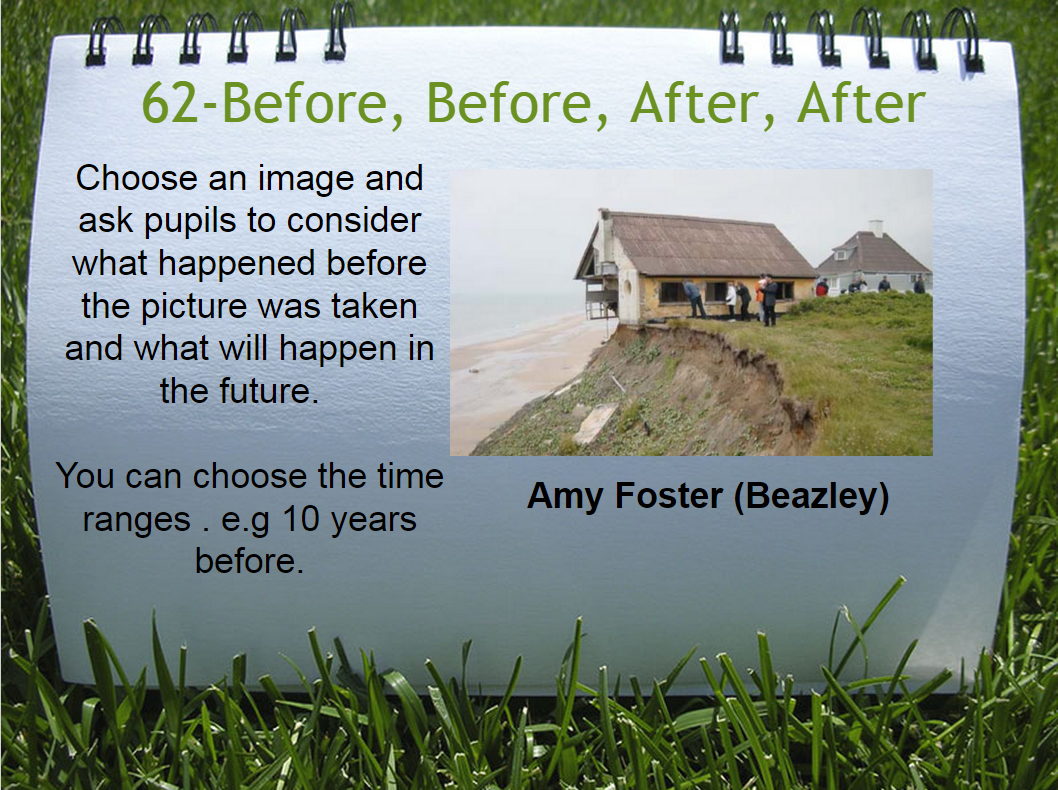
8. Images are powerful tools to have students make connections with a place. As I learned in teaching my causes of the American Revolution unit, in which students were eager to share their thoughts on pictures in the introduction, students are adept at recognizing details in a image and making inferences from them. Asking students to analyze pictures or make predictions of what will come next from a picture incorporates higher-order thinking skills. 

7. Additionally, integrating English Language Arts, pictures can also be utilized to have students work on pinpointing the 5Ws or improve visualization of a text. To practice visualization, students can sit back-to-back with one student viewing the picture and another student not viewing the picture. The student with picture in view is then challenged with the task of describing the picture in such vivid detail that the other student can draw the picture without looking at it. This is a test of both visualization, to understand how sensory language improves literature, but also of clear communication between peers. 


6. Understanding the benefits of imagery, a befuddlr activity, in which an image is scrambled, would allow students to further engage in observing details of an image. For example, students may need to look at the background landscape noticing vegetation, animals, or topography. I planned an activity similar to this in my causes of the American Revolution direct instruction lesson for guided practice, when students had to predict an image slowly uncovered by Google Presentation animation. 

5.  A cooperative learning project in which students could actively participate to bolster their knowledge of a place is creating a landscape box. There are limitless ways that students can try to recreate a place: people in correct clothing, proper animals and vegetation, architecture, technology, etc. In order to fully recreate the place, students have to know all of its characteristics. To gain this knowledge students could explore using Google Earth and... 


4. other immersive panorama technology. 360 panoramas go beyond the value of even photographs as students feel that they are really in the place, and can "look around," in essence constituting a virtual field trip. Additionally, technology such as Google Earth allows students to see the absolute and relative locations of countries on the globe. Once "zoomed in" to the country, characteristics easily abound to show students what daily life looks like in that place. Also to achieve this, I think videos could be immensely valuable. 

3. One important characteristic of places is topography, the physical features of an area. Three-dimensional excel models allow students to understand how land formations influence a place and can determine how regions are separated. While mapmaker, which allows users to add different layers to a map from political boundaries to animal migrations to CO2 admissions, does not yet appear to have a topography layer option, it would be interesting for students to compare topographical maps to political boundaries to form the generalization that geography can delineate feasible borders between countries. Furthermore, creating these models successfully integrates mathematics and science, on top of technology, to meet the powerful teaching and learning principle of integration.  

2. Building on the value of images and three-dimensional panorama technology, a webcam would allow students to view an area "live." At different times during the day over the course of months, students could "check-in" with the webcam feed and record any changes as a means of collecting data for an inquiry-based activity. In fact, different groups could each have their own webcam feed of a different area, analyze the recorded information, and draw conclusions about the physical and human characteristics of the place. 

1. My favorite way to integrate geography is by posing social studies questions for students to explore, as this most meaningfully speaks to the purpose of social studies and importance of geography as a discipline.  

If the goal of social studies it to develop students' abilities to make "informed and reasoned decisions," then students must practice applying all of the knowledge they gain about geography to situations (NCSS, 1994, p. 3). Practicing reasoning with complex information and highlighting the connections between different powers at play, will prepare students to be thoughtful global citizens. However, beyond just providing scenarios, teachers can incorporate current events or evaluate events in history by posing inquiry-based questions for students to explore. For example: Why throughout history has France easily been taken over by invading armies while Great Britain has not? Students can then respond to the question by considering the physical characteristics of both places as well as the location. Where is acid rain most prevalent in the United States and why? Students then have to collect data on accumulation of acid rain in different regions of the country, determine how acid rain is produced, locate where the highest concentration of factories are in the United States, and study maps of wind patterns. 

Overall, geography is a discipline in which students must be able to collect knowledge and then apply it to the larger issues that are happening in the world. One cannot understand the Israeli-Palestinian crisis in the Middle East, the reason Napoleon failed in Russia, or the causes behind the breakup of Yugoslavia without knowledge of geography and its themes. Thus, application of geographical knowledge is a critical skill students must form in order to become the global citizens that the world needs. 


References

Associated Press. (2006, May 2). Young Americans shaky on geographic smarts. NBC News. Retrieved on April 12, 2015, from: http://www.nbcnews.com/id/12591413/ns/us_news-education/t/young-americans-shaky-geographic-smarts/#.VSx1SvnF__E

Google. (2012, March 30). What can you do with geography? Retrieved April 14, 2015, from https://www.youtube.com/watch?v=6Mj8MTWZX4M

National Council for the Social Studies. (1994). “What Is Social Studies?” Expectations of Excellence: Curriculum Standards for Social Studies.

National Council for the Social Studies. (n.d.). National curriculum standards for social studiesRetrieved April 3, 2015, from http://www.socialstudies.org/standards/strands


Friday, April 10, 2015

Here and Now: Making Connections to Current Events


Thoughtful Planning: Nicole and I determined the focus of our current events lesson through careful consideration of the resources at our disposal: a list of suggestions for teaching current events and the available articles on Newsela. Newsela, with the slogan, "Read closely. Think critically. Be worldly," is a website dedicated to improving students' reading comprehension of nonfiction text with international news articles. First presented with this website when using it as a student, I grew to love its user-friendly annotating capabilities. Considering it from a teacher's perspective, I also appreciated that every article could be read at five lexile levels which ensures that all students can engage in high-success reading: "Whenever we design intervention for struggling readers, the single-most critical factor that will determine the success of the effort is matching struggling readers with texts they can actually read with a high level
of accuracy, fluency, and comprehension" (Allington, 2009, p. 45). Having experienced the benefits of Newsela, I decided to incorporate it into my lesson. Accessing the articles, and narrowing the search to articles published within a month of the lesson, I saw that many of the articles addressed the topic of women's empowerment. More importantly, I saw that the articles were set in places all over the world: Afghanistan, the Maldives, Chicago, Cambodia, etc. Recognizing the potential to integrate global geography I chose to modify the following activity given the Newsela articles:   

Post a map (a community, state, U.S., or world map, depending on the focus of your current events curriculum) on a bulletin board. Post stories around the map and string yarn from each story to the location on the map where the story takes place. 

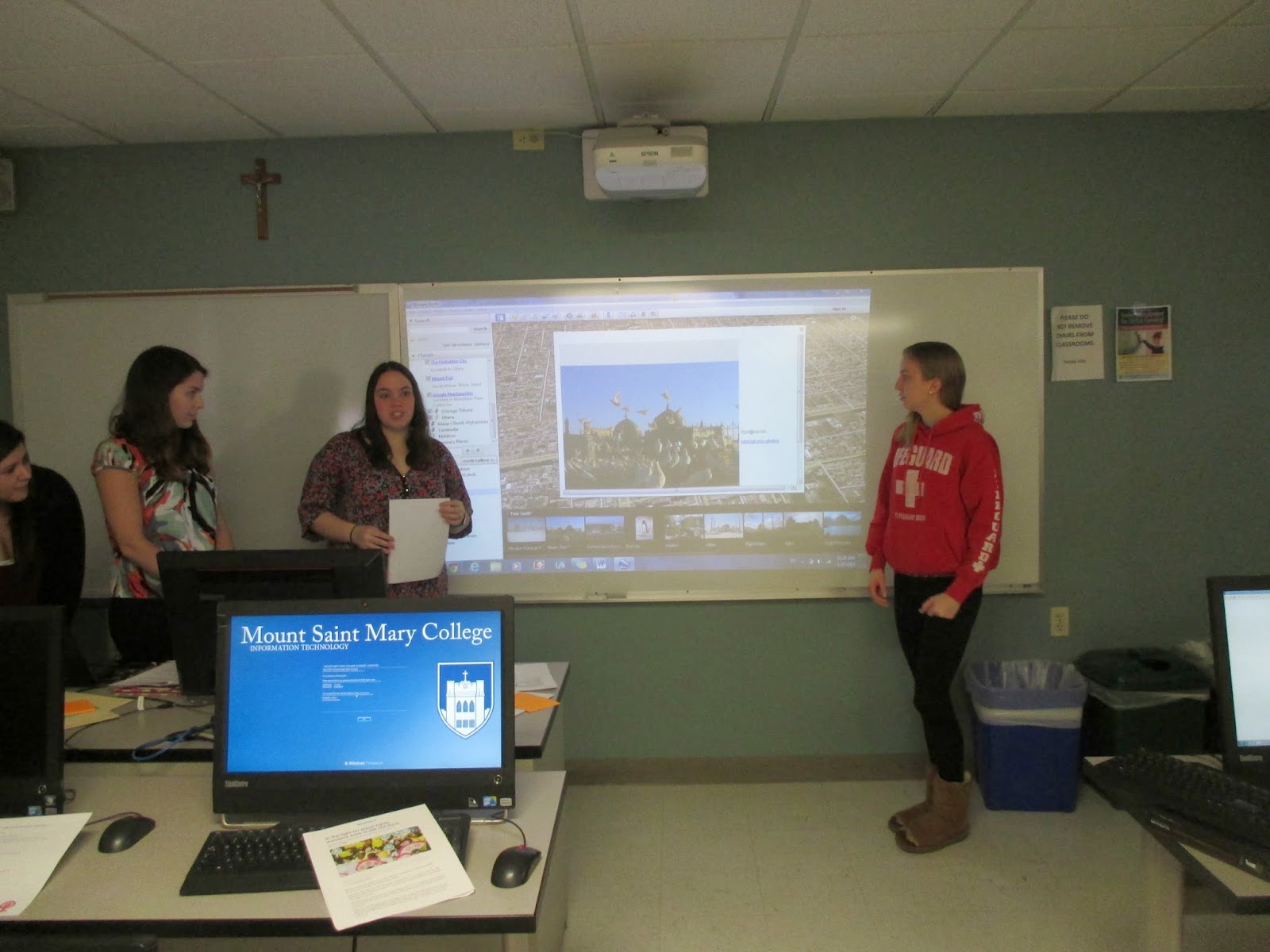
Nicole and I then planned to show a world map in our Google Presentation as the activity suggested. However, we also decided to have students utilize Google Earth so that they could appreciate what life looked like in the countries their articles featured, to expand the role of the geography discipline within the lesson.  

Reflecting on Teaching
On March 27, 2015, Nicole and I taught our current events lesson, employing a cooperative learning method, to our colleagues as if we were teaching a fourth-grade class as we did for other lessons in our unit on the American Revolution. We began the lesson by showing students a clip of the role of women in the American Revolution, drawing particular attention to the Daughters of Liberty whose boycotting we discussed in the direct instruction lesson. Students shared ideas about the role of women following the clip, and connected the video to the Newsela articles that they had read the previous night for homework. Students were asked to agree or disagree with peers' statements by moving thumbs up or down. Also as part of the introduction, students reviewed the concept of teamwork to prepare them to meet the social interaction learning objective. 

Students who had read the same article for homework came together into groups to prepare for the presentations they would make to the class. Each group was provided with a Presentation Preparation Form, that way they could
prepare to answer specific questions as part of their presentations. To ensure positive interdependence, groups had to fill out one form together and prepare a joint presentation. However, to promote individual accountability and involve all students, the questions on the presentation preparation form were color coded so that each group member needed to answer certain questions. The presentation preparation form required that students answer literal, interpretive, and applied questions in conjunction with Bloom's Taxonomy. Specifically, groups were challenged by the following questions which required them to consider both what they read in the articles, their personal experiences and viewpoints, as well as the reconciliation of those viewpoints with the viewpoints of their peers with whom they were working:

  1. Where in the world are women being empowered?
  2. What sense of this part of the world do you get from reading the article?
  3. Who is empowering women (Organization, Person, Government)?
  4. How are women being empowered? What message is being sent?
  5. What does women’s empowerment mean to you? Why is it important?

As the groups worked through their forms discussing the Newsela articles and their larger views on women's empowerment, spurred by the different levels of questions, Nicole and I circulated around the room to offer assistance and ask additional thought-provoking questions to groups in need. We were particularly impressed with how the first group, Christine and Ainsley, focused in on the individual questions assigned to them but also asked for assistance and clarification from their partners when necessary indicating promotive social interaction skills. Specifically, Christine answered one of the questions on the form and then asked Ainsley, "Do you agree with this or do I need to add something else?" This simple question led to a larger discussion on the point the group wanted to get across in their presentation. 


Next, the groups began their well-prepared presentations following the outline provided by the presentation preparation form. Additionally, the groups were able to pull up Google Earth images to share their geographic region of the world with the entire class. After every group presented, each demonstrating how women's empowerment is an issue in areas very geographically distant and culturally diverse, the class was able to agree that women's empowerment is an international issue. As a teacher and a woman, it was particularly interesting to hear peers' responses to the last question, "What does women's empowerment mean to you?" Their responses indicated an ability to evaluate a complex issue which is indicative of deep, as opposed to fragile, understanding. Similarly, by evaluating this global issue, students were develop their civic competence, specifically targeting the Common Core Social Studies Practice Standard for Civic Participation, that fourth-graders: "Participate in activities that focus on a classroom, school, community, state, or national issue or problem."

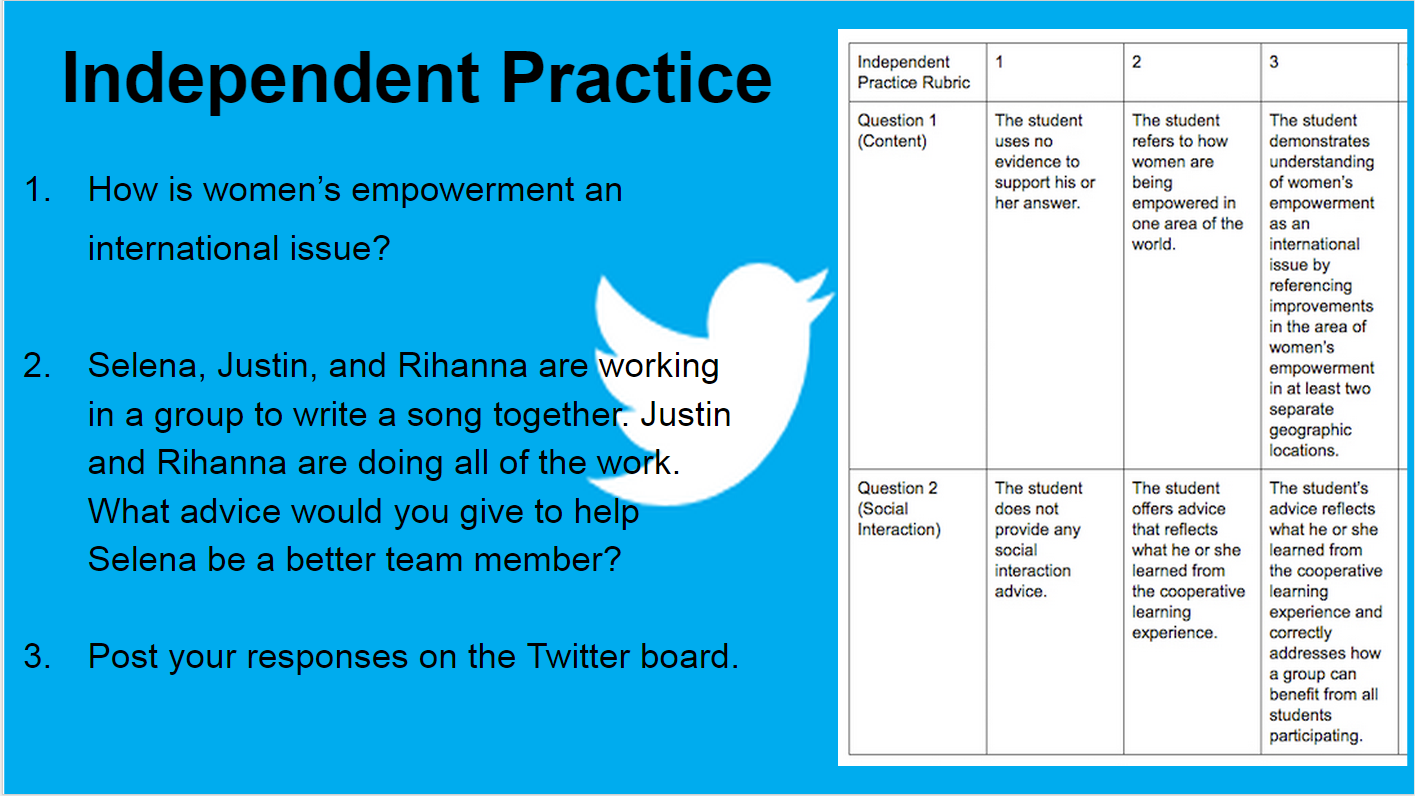
As closure, groups met the group processing element of cooperative learning by filling our peer and group evaluation forms. The students evaluated the strengths and weaknesses of their peers independently, and then discussed with each other areas in need of improvement to target in future cooperative learning experiences. Lastly, for independent practice, students were asked to post to the "twitter board" as a more creative exit-ticket style independent practice assessment. In a classroom with accessible technology allowing for a computer or iPad for every student, it would be wise to actually have students post on a social media interface or classroom forum, such as padlet which colleagues of mine utilized in their current events project. However, for classrooms without easy access to technology, using a twitter board like the one we created will allow students to easily post their thoughts in a creative and motivating way. If the twitter board was placed next to the classroom door, students could quickly post their comments as they walked out the door. For this lesson, to meet both content and social interaction objectives, students had to answer two questions according to a rubric provided to them through the Google Presentation. 


At the end of the lesson, together, as teacher candidates, we discussed how this lesson could be adapted for other grade levels. We all unanimously agreed that in younger grades, it would be more effective to have all students read the same article, especially if the teacher still wanted to use a Newsela article because he or she would most likely need to read it aloud first as the lowest lexiles available for Newsela are aligned with the upper elementary grades. First and second graders, after listening to the article read aloud, could engage in conversations with each other on certain elements of the article. Similarly, the teacher could assign each group a certain W question. For example, group one could answer the question WHO?, looking at personality traits, while another group answers the WHERE? question and explores the geographic region featured in the article using pictures provided by the teacher. 

The current events lesson achieved the five principles for powerful social studies teaching and learning. The lesson was meaningful as it emphasized deep understanding of one issue "for understanding, appreciation, and life application," as opposed to covering many topics which would lead students to only develop fragile knowledge (NCSS). Secondly, the lesson successfully integrated technology through the use of a Google Presentation, video clips, and Google Earth. Similarly, the lesson integrated many disciplines within social studies, such as geography, history, politics and philosophy, and also incorporated Common Core English Language Arts standards. Thirdly, the lesson was value-based because it tackled the controversial issue of women's empowerment around the world which reflects the value-based characteristic that: "Powerful social studies teaching considers the ethical dimensions of topics and addresses controversial issues, providing an arena for reflective development of concern for the common good and application of social values" (NCSS). Students were asked to consider the significance of women's empowerment and evaluate it in terms of their own lives. Fourthly, the lesson challenged students "to strive to accomplish the instructional goals, both as individuals and as group members" and required "well-reasoned arguments" as a part of their group presentations and independent practice responses (NCSS). Lastly, the lesson was active in that students had to evaluate a controversial issue from the information provided to them in the nonfiction articles featuring women around the world. Students engaged in reflective thinking and peer discussions in order to develop generalizations beyond the knowledge provided to them in the Newsela readings.     

Personally, I love discussing current events and am excited to share this love with my students. I believe current events provide an excellent entry point for integrating many different disciplines within social studies to one topic. Similarly, students recognize how all of the disciplines play in role in understanding the world around us presently. Thus, current events lessons are beneficial additions to unit plans as they help to meet the National Council for the Social Studies' goal that: "K–12 social studies programs integrate knowledge, skills, and attitudes within and across disciplines." 


References

Allington, R.L. (2009). What really matters in response to intervention: Research-based designs. Boston, MA: Pearson.

Lozoya, A., Farias, D., Trevino, P., Mar, E., & Vera, G. (2010, April 30). The Daughters of Liberty. Retrieved April 6, 2015, from https://www.youtube.com/watch?v=Y2I4FmaCJXM

More information about questioning. (n.d.). Retrieved April 10, 2015, from http://www.consultfourkids.com/free/materials/Blooms_Taxonomy.pdf

National Council for the Social Studies. “Principles of Teaching and Learning.” Expectations of Excellence: Curriculum Standards for Social Studies.

National Council for the Social Studies. (1994). “What Is Social Studies?” Expectations of Excellence: Curriculum Standards for Social Studies.

Newsela | Nonfiction Literacy and Current Events. (n.d.). Retrieved April 10, 2015, from https://newsela.com/

New York State Education Department. (2015). New York State K-12 social studies framework. Retrieved April 4, 2015, from https://www.engageny.org/resource/new-york-state-k-12-social-studies-framework