Learning with Artifact Bags:
 To introduce us to the the artifact bag activity within an inquiry lesson, Dr. Smirnova modeled facilitating the activity with artifacts from her life in Russia. Teacher candidates were required to make meaning from artifacts such as photographs, legal documents, and tangible objects, even utilizing translating technologies to understand Russian text. Next, teacher candidates explored the artifacts further by researching their significance, evaluated the standard questions: who? what? when? where? why?, and lastly arrived at conclusions. In this way, teacher candidates applied the inquiry method to the information presented to them through the artifact bags to construct meaningful generalizations.
Also, studying primary sources within the discipline of history prepared me for planning an artifact bag activity. Prior to this
project, I understood the discipline of history and the importance of
incorporating primary documents, however was unfamiliar with the underlying
benefits of artifact bags in terms of learning targets and motivation. Being a
history major, I have long interpreted history as the collective story of our
past as a human community, built on the interplay of individual experiences throughout
the world. Understanding the role of individual perspective in shaping history,
I recognized the value of primary sources as a means to engage students in
identifying the emotional aspect to history: “Primary sources fascinate
students because they are
real and they are personal; history is humanized through them” (National Archives and Records
Administration). However, even more meaningful,
when presented with different accounts of events through primary sources,
students can apply higher-order thinking skills to evaluate and attempt to
reconcile the juxtaposing perspectives:
 that
incorporated my aforementioned fondness for infusing primary sources into my
curriculum under the disguise of the newly discovered artifact bag approach,
with its intriguing bags motivating students with an “irresistible invitation
to learning that cannot easily be forgotten” (Fuhler, Farris, & Nelson,
2006, p. 656). Therefore, before this project, I recognized
the content and reasoning objectives I wanted students to master, however, was
unaware of the artifact bag activity as a means of having students actively
construct the knowledge and skills with high motivation and interest.
that
incorporated my aforementioned fondness for infusing primary sources into my
curriculum under the disguise of the newly discovered artifact bag approach,
with its intriguing bags motivating students with an “irresistible invitation
to learning that cannot easily be forgotten” (Fuhler, Farris, & Nelson,
2006, p. 656). Therefore, before this project, I recognized
the content and reasoning objectives I wanted students to master, however, was
unaware of the artifact bag activity as a means of having students actively
construct the knowledge and skills with high motivation and interest.
By using primary sources, students
learn to recognize how a point of view and a bias affect evidence, what
contradictions and other limitations exist within a given source, and to what
extent sources are reliable. Essential among these skills is the ability to
understand and make appropriate use of many sources of information. Development
of these skills is important not only to historical research but also to a
citizenship where people are able to evaluate the information needed to
maintain a free society (National Archives and Records Administration).
Therefore, before the artifact bag project and the
focus on teaching the discipline of history, I was aware of the teaching power
of primary sources, however, I do not believe I categorized them as artifacts.
In my mind, artifacts were only physical, tangible objects, when in actuality, “one type of artifact [is] primary
sources…includ[ing] diaries, letters, photographs, maps, audio and video
recordings, and music” (Fuhler, Farris, Nelson, 2006, p. 655). Thus,
recognizing primary sources as artifacts allowed me to design a lesson

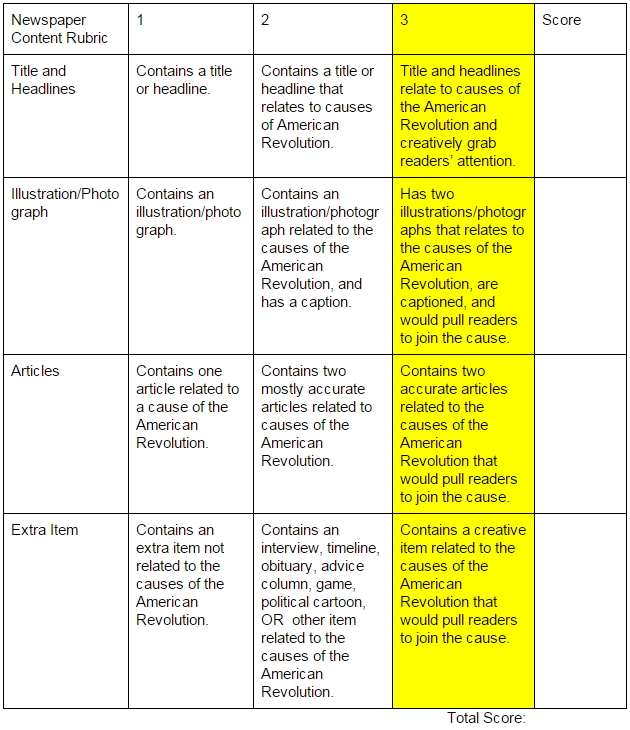
In designing the artifact bag activity for the students to experience, I selected artifacts, literature, and websites that would enhance content knowledge, genuinely challenge students to make the inquiry process meaningful, smoothly complement other lessons to maximize students’ mastery of goals for the unit, and provide a range of artifacts to meet fourth-grade state standards. The social studies unit focused on the causes of the American Revolution, and thus, the artifacts had to correspond with the historical period between 1763 and 1776. However, as I planned to begin my unit with a direct instruction lesson to maximize background knowledge for the rest of the lessons within the unit, I needed to ensure that students had the opportunity to gain new knowledge and not be presented with artifacts for which thorough explanations had already been provided. Thus, I set out to find additional information that went beyond the scope of my direct instruction lesson, and would provide students freedom in constructing their own generalizations knowing that inquiry-based learning is structured to “provide students with opportunities to learn with more freedom” and apply “funds of knowledge” (Ohio Department of Education). In the process of finding new information for my students, I also uncovered historical content with which I was not previously familiar. Searching the Mount Saint Mary College library for lesson resources, I found two non-fiction picture books, appropriate for fourth graders, that detailed valuable information about the causes of the American Revolution that had not been stressed in the direct instruction lesson and served as an excellent connection to the next lesson in the unit that focused on the current event of women’s empowerment globally. Therefore, the two books I selected as data collecting resources for students were Anderson and Faulkner’s (2008) Independent Dames: What You Never Knew about the Women and Girls of the American Revolution and Roberts and Goode’s (2014) Founding Mothers: Remembering the Ladies, confirming that “for inquiry-based learning, nonfiction books are a mainstay” (Ohio Department of Education). From reading these books, I came away with the understanding that women were central to causing and winning the American Revolution both directly through actions and indirectly through influence over male power holders at the time. This is exactly one of the overarching generalizations that I wanted students to obtain through the lesson, and thus, in my subsequent readings of the material, I created a list of possible artifacts that through implementation of the inquiry process would lead students towards this generalization.
Planning/Teaching with Artifact Bags:
 In planning
the artifact bag lesson, I endeavored to follow the
guidelines set forth by Fuhler, Farris, and Nelson (2006) in their article,
“Building literacy skills across the curriculum: Forging connections with the
past through artifacts.” Thus, I began by activating students’ prior knowledge
about the inquiry process as well as the unit topic, the causes of the American
Revolution, as they had already accessed the basic factual knowledge in an
earlier direct instruction lesson. This review served to minimize the strain on
students’ working memory and allow students to recall important elements that I
wanted them to connect to the new information they would uncover in the inquiry
lesson: “It is important for a teacher to help students recall the concepts and
vocabulary that will be relevant for the day’s lesson because working memory is
very limited” (Rosenshine, 2012, p. 13). Next, as suggested by Fuhler, Farris,
and Nelson (2006), I utilized teacher modeling while thinking-aloud to scaffold
students’ inquiry process, “using an artifact that is unrelated to those with
which the [students] will be working” (p. 648). Drawing attention to the
uniquely decorated “mail carriers” replicating mail delivery in history, in
place of typical bags, I began modeling what the students would need to do: I
opened the carrier and revealed a mysterious object, a souvenir from the
Netherlands, a painted wooden shoe; I offered my quizzical thoughts appraising
the unknown object; I wrote down a description of the artifact and questions
for which I wanted to find answers regarding the artifact on my Artifact Bag
Discovery Guide. After generating
questions, I probed the students about what I would need to do next in order to
fulfill the inquiry process. The resulting answers delineated the plan:
hypothesize the meaning behind the object, then collect data through resources
such as websites and books, and lastly, analyze that data to draw conclusions.
I expedited this process by summarizing for students what happened when I
actually went through this process, showing the website resource, and filling
out the “Discoveries” section on the Artifact Bag Discovery Guide. Given this
scaffold and a copy of my worked example to consult, students were well prepared
to commence the challenge of discovering the three artifacts in the remaining
mail carriers.
In planning
the artifact bag lesson, I endeavored to follow the
guidelines set forth by Fuhler, Farris, and Nelson (2006) in their article,
“Building literacy skills across the curriculum: Forging connections with the
past through artifacts.” Thus, I began by activating students’ prior knowledge
about the inquiry process as well as the unit topic, the causes of the American
Revolution, as they had already accessed the basic factual knowledge in an
earlier direct instruction lesson. This review served to minimize the strain on
students’ working memory and allow students to recall important elements that I
wanted them to connect to the new information they would uncover in the inquiry
lesson: “It is important for a teacher to help students recall the concepts and
vocabulary that will be relevant for the day’s lesson because working memory is
very limited” (Rosenshine, 2012, p. 13). Next, as suggested by Fuhler, Farris,
and Nelson (2006), I utilized teacher modeling while thinking-aloud to scaffold
students’ inquiry process, “using an artifact that is unrelated to those with
which the [students] will be working” (p. 648). Drawing attention to the
uniquely decorated “mail carriers” replicating mail delivery in history, in
place of typical bags, I began modeling what the students would need to do: I
opened the carrier and revealed a mysterious object, a souvenir from the
Netherlands, a painted wooden shoe; I offered my quizzical thoughts appraising
the unknown object; I wrote down a description of the artifact and questions
for which I wanted to find answers regarding the artifact on my Artifact Bag
Discovery Guide. After generating
questions, I probed the students about what I would need to do next in order to
fulfill the inquiry process. The resulting answers delineated the plan:
hypothesize the meaning behind the object, then collect data through resources
such as websites and books, and lastly, analyze that data to draw conclusions.
I expedited this process by summarizing for students what happened when I
actually went through this process, showing the website resource, and filling
out the “Discoveries” section on the Artifact Bag Discovery Guide. Given this
scaffold and a copy of my worked example to consult, students were well prepared
to commence the challenge of discovering the three artifacts in the remaining
mail carriers.


A wide range of artifacts had to be creatively presented in order to meet the objective of the lesson and target standards. For instance, I wanted a copy of the Boycott Agreement of the Boston Women (1770) complete with 300 signatures as it was discussed in both books and also constituted a new discovery for me. However, after much searching, it was unattainable. Instead, I had to try to remake a Boston Evening-Gazette covering the material, using quoted material I could find, a heading from another day’s entry of the Boston Evening-Gazette, and creatively crafted burned “parchment.” After, having secured this article, I wanted to incorporate other types of artifacts too. Thus, for my second artifact, I provided tangible buttons and thread to represent the homespun clothing movement to encourage colonial women to boycott British goods. Lastly, I utilized a photograph of the cover of Phillis Wheatley’s book of poems. It was my hope that selecting three different types of artifacts would broaden students’ experiences working with artifacts as well as better target the Common Core Practice Standard for fourth-grade social studies: “Gathering, Interpreting, and Using Evidence: Recognize, use, and analyze different forms of evidence to make meaning in social studies (including primary and secondary sources, such as art and photographs, artifacts, oral histories, maps, and graphs).” Similarly, the three artifacts I chose also perfectly corresponded to further information that students could explore with pre-selected resources. In addition to the books, I chose to incorporate websites as additional resources for students to utilize to collect and analyze data understanding that: “It is vitally important in today’s classrooms to have technological literacy woven smoothly into the standard book-related literacies” (Fuhler, Farris, & Nelson, 2006, p. 648). Thus, wanting students to explore the artifacts made available to them in greater detail and to answer their specific questions as well as add to the formation of the generalization, I found museum and historical society websites to shed light on the role of the artifacts in causing the American Revolution. Accordingly, together, the artifacts, literature, and websites provide the information which students will analyze and evaluate, aided by social interaction with peers, to form generalizations. In other words, these resources are crucial in framing students’ learning journey as: “Inquiry-based learning is a complex process where students attempt to convert information into useful knowledge through a structure of identifying ‘real’ questions, finding resources to gather information in answering the ‘real’ question, interpreting the information and reporting the findings” (Ohio Department of Education).
Reflection on Artifact Bags:

As the description of the activity and objectives for the lesson should emphasize, the artifact bag inquiry-based lesson implements the National Council for the Social Studies’ (1994) five principles of powerful teaching and learning, that instruction be: meaningful, integrative, value-based, challenging, and active. Firstly, artifact bag lessons are meaningful because they concentrate on students developing connections between knowledge and skills in ways that they understand; students “ponder different artifacts, drawing from personal experiences initially to make sense of the object at hand” (Fuhler, Farris, & Nelson, 2006, p. 651). Similarly, the inquiry process in which students are actively working is developing genuine thinking skills that are “important ideas for understanding, appreciation, and life application” (National Council for the Social Studies, 1994). Secondly, this activity is integrative as it has limitless potential in terms of incorporating both technology and other content areas, in particular English Language Arts. In my own lesson, technology was incorporated through the use of websites; however, to better capitalize on technology, teachers could utilize Quick Response (QR) codes linking students to audio and video files which also serve as artifacts. Also, as there are countless ways to make artifact bags cross-curricular, my social studies lesson also targeted fourth-grade Common Core English Language Arts standards such as: CCSS.ELA.RI.4.9. “Integrate information from two texts on the same topic in order to write or speak about the subject knowledgeably,” and CCSS.ELA.W.4.2. “Write informative/explanatory texts to examine a topic and convey ideas and information clearly.” Thirdly, the value-based principle is achieved through the incorporation of primary sources as artifacts and the ensuing “debate[s] with teachers and classmates about the interpretation of [those] sources” (National Archives and Records Administration). Therefore, the lesson meets the value-based principle as it encourages students’ “recognition of opposing points of view and respect for well-supported positions” (National Council for the Social Studies, 1994). Fourthly, artifact bag activities are challenging as students must enact the inquiry process and provide well-reasoned arguments in support of conclusions drawn: “learners construct meaning during authentic interactions that enable them to negotiate, evaluate, and transform the knowledge they acquire – a more effective process than simply memorizing teacher-disseminated information” (Fuhler, Farris, & Nelson, 2006, p. 646). Lastly, the artifact bag lesson is active because it champions constructivist theory’s emphasis on student-centered knowledge construction. The students work through the inquiry process and consult with peers to arrive at their conclusions, with teacher acting as facilitator as opposed to lecturer.
Generalizations from Artifact Bag Lessons:

Teaching History Channel. (2010, November 10). Teaching with Artifacts. Retrieved April 8, 2015, from https://www.youtube.com/watch?v=oQDA1pdC7nQ
As the description of the activity and objectives for the lesson should emphasize, the artifact bag inquiry-based lesson implements the National Council for the Social Studies’ (1994) five principles of powerful teaching and learning, that instruction be: meaningful, integrative, value-based, challenging, and active. Firstly, artifact bag lessons are meaningful because they concentrate on students developing connections between knowledge and skills in ways that they understand; students “ponder different artifacts, drawing from personal experiences initially to make sense of the object at hand” (Fuhler, Farris, & Nelson, 2006, p. 651). Similarly, the inquiry process in which students are actively working is developing genuine thinking skills that are “important ideas for understanding, appreciation, and life application” (National Council for the Social Studies, 1994). Secondly, this activity is integrative as it has limitless potential in terms of incorporating both technology and other content areas, in particular English Language Arts. In my own lesson, technology was incorporated through the use of websites; however, to better capitalize on technology, teachers could utilize Quick Response (QR) codes linking students to audio and video files which also serve as artifacts. Also, as there are countless ways to make artifact bags cross-curricular, my social studies lesson also targeted fourth-grade Common Core English Language Arts standards such as: CCSS.ELA.RI.4.9. “Integrate information from two texts on the same topic in order to write or speak about the subject knowledgeably,” and CCSS.ELA.W.4.2. “Write informative/explanatory texts to examine a topic and convey ideas and information clearly.” Thirdly, the value-based principle is achieved through the incorporation of primary sources as artifacts and the ensuing “debate[s] with teachers and classmates about the interpretation of [those] sources” (National Archives and Records Administration). Therefore, the lesson meets the value-based principle as it encourages students’ “recognition of opposing points of view and respect for well-supported positions” (National Council for the Social Studies, 1994). Fourthly, artifact bag activities are challenging as students must enact the inquiry process and provide well-reasoned arguments in support of conclusions drawn: “learners construct meaning during authentic interactions that enable them to negotiate, evaluate, and transform the knowledge they acquire – a more effective process than simply memorizing teacher-disseminated information” (Fuhler, Farris, & Nelson, 2006, p. 646). Lastly, the artifact bag lesson is active because it champions constructivist theory’s emphasis on student-centered knowledge construction. The students work through the inquiry process and consult with peers to arrive at their conclusions, with teacher acting as facilitator as opposed to lecturer.
Generalizations from Artifact Bag Lessons:
Therefore, the artifact bag activity as part of an inquiry-based lesson
helps to develop students’ content knowledge and reasoning skills in accordance
with national and state standards. Artifact bag activities can be adapted to effectively target content and reasoning objectives for all grade levels. Furthermore, the use of intriguing artifact
bags and tangible artifacts spurs student enthusiasm and engagement for the lesson.
This enthusiasm is then carried throughout the lesson as students are called to
actively engage with peers to construct their own knowledge, bringing in their
personal experiences to connect to the new material. Learning how to teach a
successful artifact bag lesson is an important pedagogical skill considering
all of the aforementioned benefits and as it ensures that I am incorporating
the five principles of powerful social studies teaching in my classroom
instruction.
References
Anderson, L.,
& Faulkner, M. (2008). Independent
dames: What you never knew about the women and girls of the American Revolution.
New York, New York: Simon & Schuster Books for Young Readers.
Cunningham,
P.M., & Allington, R.L. (2011). Classrooms
that work: They can all read and write (5th ed.). Boston, MA:
Allyn & Bacon.
Fuhler, C.,
Farris, P., & Nelson, P. (2006). Building literacy skills across the
curriculum: Forging connections with the past through artifacts. The Reading
Teacher, 59(7), 646-659.
Massachusetts Historical Society. (n.d.).
Non-consumption and Non-importation. Retrieved April 4, 2015, from
http://www.masshist.org/revolution/non_importation.php
National Archives and Records
Administration. (n.d.). History in the raw. Retrieved April 4, 2015, from
http://www.archives.gov/education/research/history-in-the-raw.html
National
Council for the Social Studies. (1994). Expectations
of Excellence: Curriculum Standards for Social Studies. Washington, D.C.:
NCSS.
National Council for the Social
Studies. (n.d.). National curriculum standards for social studies. Retrieved
April 3, 2015, from http://www.socialstudies.org/standards/strands
National Women's History Museum. (n.d.). Phillis Wheatley. Retrieved
April 5, 2015, from https://www.nwhm.org/education-resources/biography/biographies/phillis-wheatley/
New York State Education Department. (2011). New York State P-12 Common
Core learning standards for ELA and literacy. Retrieved April 4, 2015, from
https://www.engageny.org/resource/new-york-state-p-12-common-core-learning-standards-for-english-language-arts-and-literacy
New York State Education Department. (2015). New York State K-12 social
studies framework. Retrieved April 4, 2015, from https://www.engageny.org/resource/new-york-state-k-12-social-studies-framework
Ohio Department of Education.
(n.d.). The evidence base for social studies: Inquiry-based learning. Retrieved
April 3, 2015, from http://ims.ode.state.oh.us/ode/ims/rrt/research/Content/inquiry_based_learning_what_we_know.asp
Roberts, C.,
& Goode, D. (2014). Founding mothers:
Remembering the ladies. New York, New York: HarperCollins.
Rosenshine, B. (2012). Principles of
instruction: Research-based strategies that all teachers should know. American Educator, 36(1), 12-19, 39.
Teaching History Channel. (2010, November 10). Teaching with Artifacts. Retrieved April 8, 2015, from https://www.youtube.com/watch?v=oQDA1pdC7nQ




.png)